View Charts
Flying Eagle Pennies (1856-1858)
Composed of 88% Copper and 12% Nickel, Flying Eagle Cents were produced from 1856 - 1858. They had the same diameter as the later Lincoln cent but were notably a bit thicker and heavier. Although the Flying Eagle Penny was only minted for two years, it continues to be a sought-after addition for many collector’s portfolios to this day. Designed by the US Mint’s chief engraver at the time, James Longacre, Flying Eagle Pennies remain an important part of US coinage history. Because of the difficulty experienced with striking these coins, the US Mint replaced the Flying Eagles with a different cent in 1859. It was called the Indian Head Penny and was also designed by Longacre.
History of the Flying Eagle Cent
The first cent coins that the US Mint produced were called “Large Cents” which were bigger than modern-day US Quarters. Due to the increased fluctuations in the price of copper in the 1850s, the US Mint began to seek alternatives, which included decreasing the size of the cent as well as adjusting the coin’s composition to include other metals besides pure copper. This resulted in the production of the first “Small Cent”, the Flying Eagle.
In 1854, Mint Director James Ross Snowden advocated for the issue of small, bronze cents in his annual report. He also encouraged the elimination of the half-cent, which he characterized as impractical in commerce. Pattern cents (practice coins struck to test the designs) were struck in 1854 and 1855, including designs inspired by the work of late US Mint Chief Engraver Christian Gobrecht. In July 1856, Snowden wrote to Secretary of the Treasury James Guthrie, proposing the metal composition of 88% copper and 12% nickel. He also wrote to Guthrie to hammer out the details of the coin’s future weight. While the legislation to introduce a new size for the cent coins was under review, Snowden requested that Chief Engraver James Longacre work up a flying eagle design and had the dies prepared in November 1856. The legislation finally passed, and production started on the Flying Eagle Cents in April 1857. However, they were not officially released until May 25th, 1857.
Unfortunately, the US Mint had trouble striking the new design. The hard copper-nickel alloy led to increased die breakage after efforts to bring out the design more fully. Also, the eagle on one side of the piece was directly opposite parts of the reverse design on the other side, increasing the striking difficulties.
The Mint attempted to alleviate the breakage issue in 1858 by producing a new version of the cent with a shallower relief. This change led to the major variety in the series, as the newer coins had smaller letters in the inscriptions than the letters in the original design.
Design of the Flying Eagle Cent
The coin’s obverse of a flying eagle is based on the Gobrecht dollar, which was struck between 1836 and 1839. Designed by James Longacre, the eagle is depicted in mid-flight while facing to the left. The inscription “UNITED STATES OF AMERICA” borders the upper rim, while the date is shown below the bird. The reverse, also designed by Longacre, displays the coin’s denomination of “ONE CENT” encircled by a wreath.
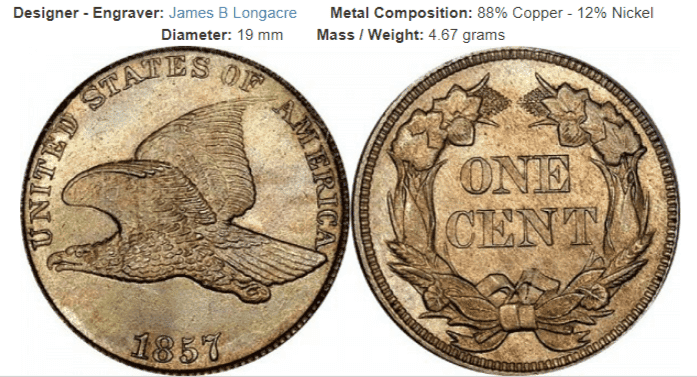
Image source: https://www.usacoinbook.com
Value of the Flying Eagle Cent
On average, Flying Eagle Pennies are a fairly valuable collector item. They generally range from $25-400, depending on the condition. However, there are a couple varieties that stand out due to their rarity and/or low mintage.
1856 Flying Eagle Cent
Value: Between $7,000 and $19,000, depending on condition
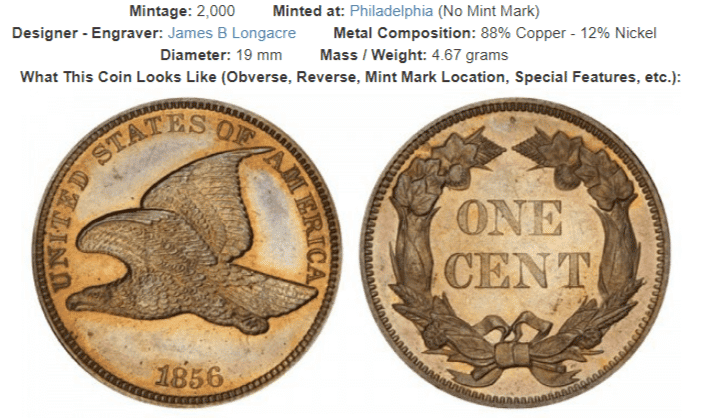
Image source: https://www.usacoinbook.com
1858 Flying Eagle Cent: 8 over 7
(1888 date was punched over an 1887 date, resulting in a 7 slightly visible under the final 8. Also, the tip of the eagle’s wing is slightly broken up)
Value: Between $75 and $10,500, depending on condition
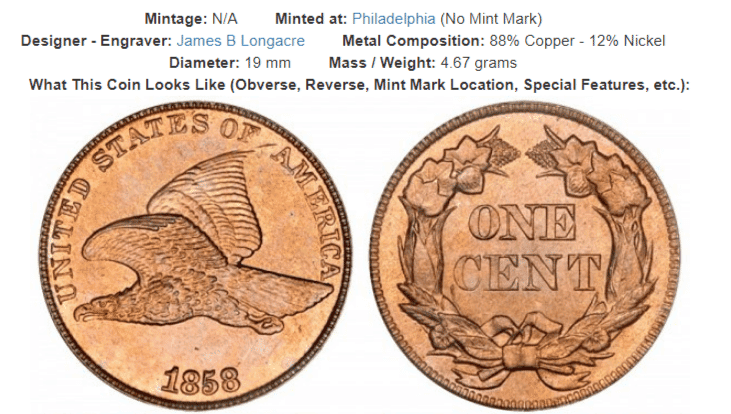
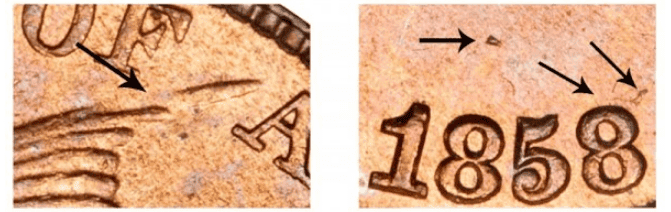
Image source: https://www.usacoinbook.com
Because the Flying Eagle Cent was minted in such a short span of time, they are incredibly popular among collectors regardless of value. As is most often the case, the better the condition of the coin, the more it would be worth. If you manage to find one in your possession, it is highly recommended to contact a numismatic professional for assistance in determining the value of your coin.